
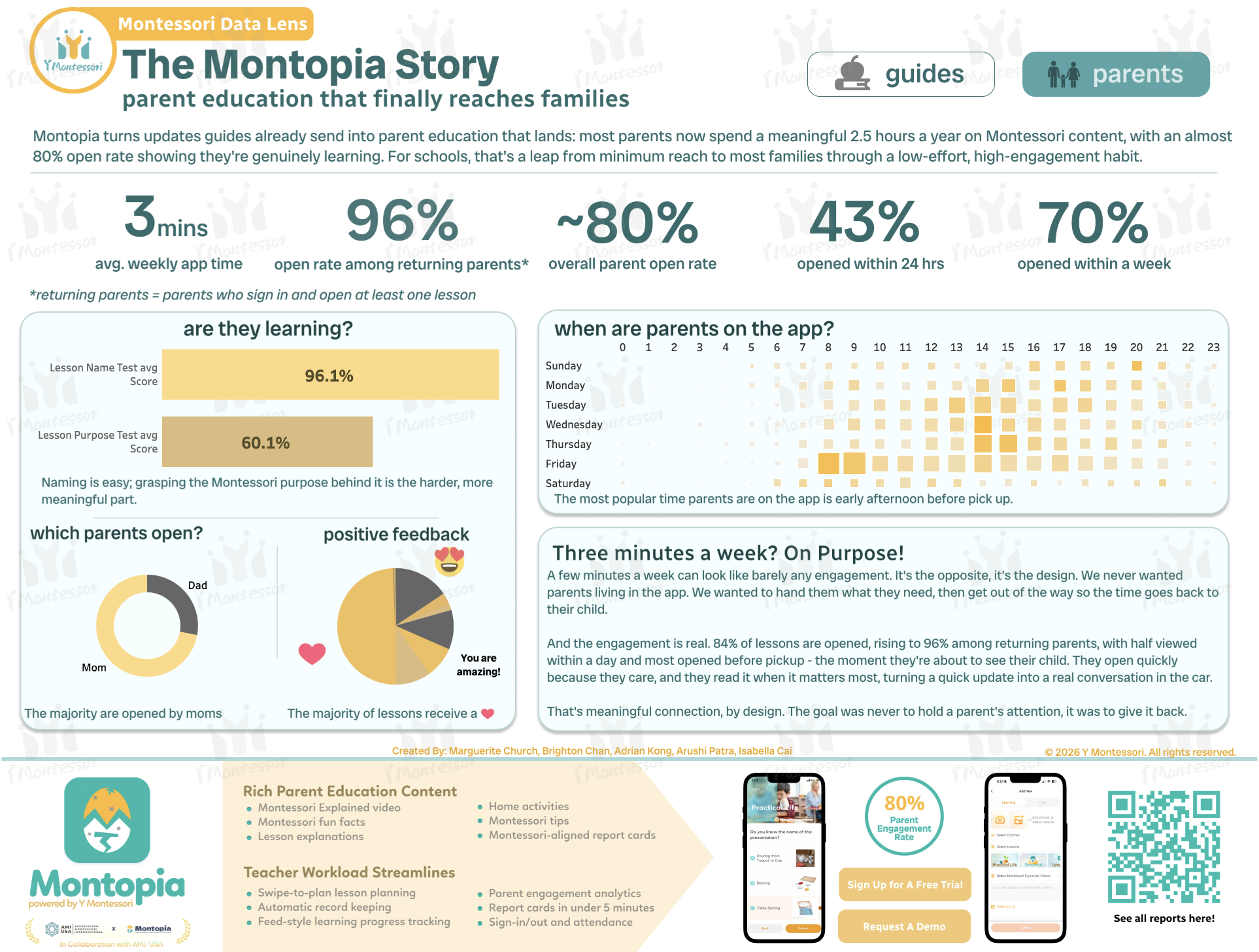
If you wanted to design a metric to make parents look disengaged, you could hardly do better than the one we found first: the average parent spends about three minutes a week in Montopia, a parent engagement app for Montessori schools.
Three minutes a week becomes two and a half hours a year, barely the equivalent of a couple of parent nights. It’s the kind of number that sounds small until you remember what it’s being compared against.
On its face, it reads like a number you’d bury in a slide deck and hope nobody asked about. Then we looked at what those three minutes contained, and the story turned over completely.
The number that changes the first number
Parents open almost 80% of the lessons their school sends them, and among active parents, who we define as having opened at least one lesson, that figure climbs to 96%. They open nearly everything. And they open them fast: 43% within the first 24 hours, 70% within the week.
That combination is the interesting part. Low time, high open rate, short lag. Those three numbers don't usually travel together. High engagement normally costs time; low time usually means content gets ignored. Here it doesn't. Parents are spending almost nothing and opening almost everything, almost immediately.
The three-minute figure, in other words, isn't a measure of how little parents care. It's a measure of how efficiently they engage when the format respects their week.
The metric we deliberately don't chase
Here's where we have to be honest about something, because it shapes every number in this report.
Almost every app you use is built to keep you in it. The industry's defining metric is time-on-app: minutes per session, sessions per day, the endless scroll engineered so you look up and an hour is gone. Engagement, in that world, means staying.
We measure the opposite. We consider three minutes a success, not a shortfall. The design goal was never to hold a parent's attention. It was to hand them something worth carrying back to their child, and then get out of the way. A good session, by our definition, ends with the phone face-down and the parent watching their kid pour water with new eyes, not staring at a feed.
That sounds like a soft, feel-good distinction until you see what it does to the dashboard. When you stop optimizing for time-in-app, you have to find other things to optimize for, and those turned out to be the numbers that actually matter:
- How much they learn, measured by what they retain on post-lesson checks: over 95% on a lesson's name, 60% on its purpose. Not how long they lingered.
- How fast they engage, measured by the gap between a lesson being sent and opened: 43% within 24 hours, 70% within the week. Not how many times we could pull them back.
- How many engage at all, measured across the whole parent body: an 79% open rate across all lessons sent, 96% among active parents.
Short, fast, broad, and retained. That's the scoreboard. Time-on-app isn't on it, on purpose. And the three-minute number stops looking like a problem the moment you realize it's the result we were aiming for.
When they open is the whole point
There's one more timestamp worth dwelling on, and it's the one that ties the philosophy to real life.
Parent opens aren't spread evenly across the day. They cluster in the early afternoon, right before pickup, the window when a parent is about to pull up to their child or has just made it home with the kid in tow. That is the most-active time on the app, across most weekdays.
That timing isn't incidental to the value. It may be the value. A lesson opened just before pickup isn't abstract anymore. The child who spent the morning on a particular work is about to walk out to the car. The parent has the context in one hand and their kid in the other, and the conversation that follows (“tell me what you built today”) has something real to attach to. The app's job in that moment isn't to be interesting. It's to be brief, to land the context, and to disappear before it competes with the child who's actually in the room.
This is why we keep coming back to how short the sessions are rather than how long. A two-minute read that arrives at the right moment and feeds a real conversation does more than a twenty-minute session that pulls a parent away from the very child it's meant to be about. The measure that matters isn't dwell time. It's whether the open shows up at the moment a parent can use it, and the data says it does.
What “engaged” turned out to mean
That choice only works if the learning actually lands, so that's what we checked next, because an open is a weak signal on its own. Opening isn't understanding.
We measured it with a short quiz after each lesson, and the numbers split cleanly in two. On the name of the lesson (what the activity is called, what it involves) parents scored around 95%. On the purpose of the lesson (why it matters, the developmental reasoning underneath it) they scored around 60%. A note on method: those are first-attempt scores. After answering, parents see the correct response and can retake, so 60% is the cold-open number, before any reinforcement, the hardest possible reading of it.
That thirty-point gap is, to us, the most useful finding in the whole dataset. And it isn't a surprise so much as a confirmation: the “why” of Montessori has been the thing parents struggle with for as long as the method has existed. They can name what their child did. Explaining why pouring water for the fifth time builds concentration and order is the part that has always been hard to reach.
What's new is that the gap is now visible and addressable. It's not a failure; it's a map. It points to exactly where understanding is thin, the “why,” which happens to be the exact place that turns a parent from a spectator into someone who can explain Montessori to a friend. The name is trivial. The purpose is conviction. The data shows the first arriving easily, the second arriving slowly, and, because the quiz hands back the right answer and invites another try, actually being built rather than just measured.
What's possible alongside, not instead of
It's worth saying what these numbers actually make possible, because the picture is bigger than what an app can do alone.
Parent nights, classroom observations, family conferences - schools rightly value these, and they should. They're irreplaceable moments of in-person connection between a school and the families it serves. A great parent night doesn't get replicated through a screen, and we never set out to try.
What Montopia changes is what fills the space between those moments. Schools have always carried a difficult ratio: events that take hours to prepare and a few staff to run reach roughly 10 to 15 percent of families on the night. The other 85 to 90 percent get nothing in between. Not because anyone wanted it that way, but because there was no good way to reach them without asking for hours they didn't have.
That in-between is where the data describes a different kind of work happening. 2.5 hours a year of meaningful engagement, reaching 80 to 90 percent of the parent body, in the small windows families actually have. The content shows up at the right moment, in the right amount, about the parent's own child. Which is why it lands. The reading is brief, but it's followed by a real conversation in the car, a real application at home, a real piece of understanding that wasn't there yesterday.
And here's the part schools tell us they didn't expect: those steady micro-moments make the in-person events better. Parents arrive at conferences and parent nights already in the conversation. They know what their child has been working on. They have specific questions instead of general ones. The teacher isn't spending the first ten minutes catching them up; they're starting somewhere deeper. The app doesn't replace the in-person connection. It prepares the ground for it.
Why the small number is the big finding
The interesting thing about this data isn't that parents engage a lot. It's that they engage well on very little, by design, and that an app built to be put down is a strange thing to make, but the numbers suggest it might be the right one. The smallness is the discovery, not the disappointment.